
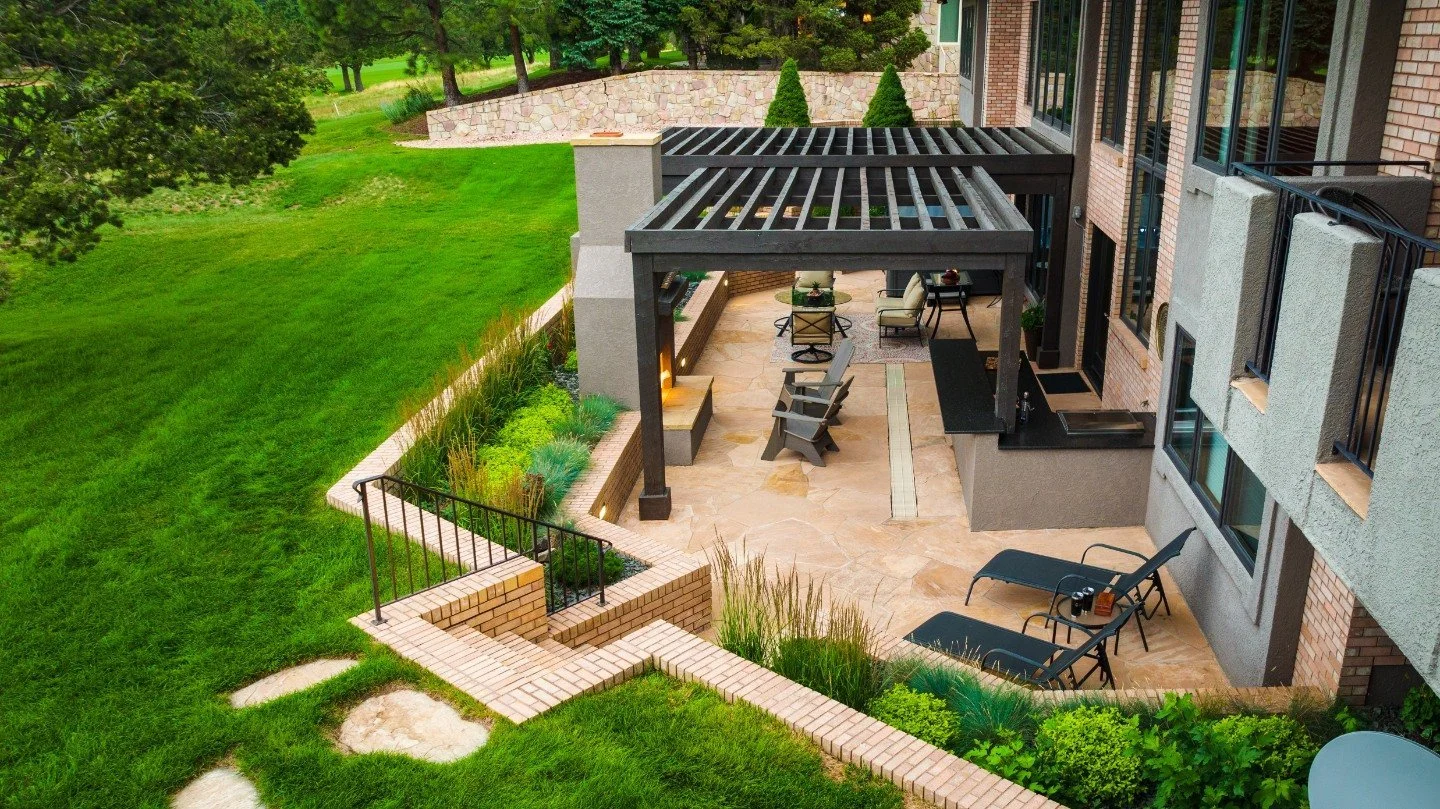
Some backyards ask you to look inward. In Castle Pines, many of the memorable ones pull your eyes toward something farther away.
The city rises and falls across rolling terrain, with pine-covered areas, open land and distant mountain views appearing between neighborhoods. Castle Pines also manages more than 1,850 acres of open space and nearly 60 miles of trails, so the surrounding landscape remains a visible part of daily life in many parts of the community.
When a property already has that kind of backdrop, a pergola becomes part of the composition. Its posts create vertical lines. Its beams establish a new horizon overhead. Even the furniture beneath it changes where people sit and which direction they face.
That makes the view a useful place to begin.
The View From the Chair
Walk through your backyard and find the seat you would choose if you had an hour with nowhere else to be.
That spot may already be obvious. Perhaps it looks toward a gap between the pines or across a lower section of the neighborhood. On a sloping lot, moving 15 or 20 feet away from the house can reveal scenery that barely registers from the patio near the back door.
Sit down before deciding where a pergola belongs. Looking from seated eye level gives you a much better sense of how posts and beams will interact with the landscape.
This is especially helpful with distant views. A mountain ridge may occupy a relatively narrow strip of the horizon. One poorly placed post can land directly in the middle of it. Shifting the pergola a small distance to one side can open that sightline again.
The view from inside deserves the same attention. A pergola becomes part of what you see through the kitchen or living room windows throughout the year. Walk back into the house and look through those windows from the places where you normally stand or sit. You may find that a location that feels perfect from the patio creates an awkward line from indoors.
Think of the Pergola as a Frame
Landscape designers sometimes talk about borrowed scenery, the idea that a view beyond your property can become part of the garden itself. Castle Pines offers plenty of opportunities to use that idea.
A pergola naturally frames whatever sits beyond its posts.
You can use that quality deliberately. If the best view is toward the west, the main opening of the pergola can face that direction. On another property, a stand of mature pines may have more character than the distant horizon. The structure can be positioned so those trees fill the opening.
Proportion becomes important here. Deep beams create a strong visual edge around the scene. Slender lines tend to fade into the background more easily. The right choice depends partly on the architecture of the house and partly on how much presence you want the pergola to have.
Castle Pines includes established homes tucked among mature vegetation along with newer development such as The Canyons, where residential areas have been planned alongside extensive open space. The Canyons alone includes more than 1,200 acres currently designated for open space in city planning documents. A pergola overlooking that kind of setting can take cues from the broader landscape instead of relying heavily on decorative detail.
Materials make a difference too. Wood can pick up tones from nearby trees and stonework. Dark structural elements can become relatively quiet against deep green vegetation. Finishes look different outside under Colorado’s strong daylight, so samples are worth viewing against the real background before making a decision.
Let Castle Pines’ Terrain Work for You
Flat backyards tend to make placement choices fairly predictable. Castle Pines gives homeowners more interesting possibilities.
A change in grade can create an overlook within your own property. A pergola placed on a lower terrace may give you a clear line across the yard while leaving the view from the house largely open. Higher ground can work beautifully for a small seating area where the landscape drops away beyond it.
This can also make the pergola feel like a destination.
A short walk from the house changes the experience of using the yard. You leave the main patio, move through planting or along a path, and arrive somewhere with its own perspective. For homeowners with enough room, that separation can make an underused section of the property much more appealing.
Furniture can follow the terrain as well. Facing every chair toward the center of a conversation area makes sense in some settings. A Castle Pines view may tempt you to turn a few seats outward. A built-in bench along one edge can create a place to sit with an uninterrupted outlook, while a dining table may work better on another side of the structure.
The arrangement starts feeling specific to the property because it grows from what is already there.
Be Selective About What Enters the Picture
Few backyard views are perfect in every direction.
One side may look toward open land while another catches a neighboring house. A utility box may sit close to the patio. Part of the yard may have a wonderful stand of trees with a roofline appearing immediately beside it.
A pergola gives you some control over where attention goes.
Post placement can define the strongest opening. Planting around another side can soften a less interesting view. Even furniture orientation helps decide which part of the landscape becomes the backdrop when people gather.
This kind of editing can be subtle. A large shrub near one corner may be enough to pull attention away from something beyond the property line. Ornamental grasses around a pergola can soften its base while allowing the longer view to remain visible above them.
The City of Castle Pines places considerable emphasis on open space and connections to the surrounding landscape in its long-range planning. Its comprehensive plan calls for expanded public open space and continued connections between neighborhoods, trails and regional natural areas. That relationship with the landscape offers a useful cue for residential design too. A backyard can feel closely tied to Castle Pines when the scenery around it is allowed to participate.
When the Mountains Fade
Late afternoon may be the reason you chose the view, but some of the best time beneath a pergola comes later.
As the landscape darkens, attention moves closer to the table and the people around it. Lighting can help that transition happen gently.
Fixtures tucked into overhead beams keep the source of the light less conspicuous. Light directed downward gives you enough illumination for dinner or conversation while preserving the darker landscape beyond the structure. Bright light aimed outward can create glare and make distant scenery harder to see as dusk settles in.
A fire feature nearby can add another layer of light, especially during cooler Castle Pines evenings. Its placement matters when a view is involved. Keeping taller elements toward the edges of the primary sightline allows the center of the scene to stay open.
The result can feel entirely different from the same spot at four in the afternoon. During the day, the pergola frames the larger landscape. By night, it becomes a more intimate place within it.
Give the View a Place in the Plan
A pergola for a Castle Pines home can begin with a surprisingly uncomplicated question: What do you want to be looking at when you sit beneath it?
That answer can guide far more of the design than a catalog of pergola styles. It can influence where the structure sits on the property, how high the beams rise and where people naturally gather once the furniture is in place.
All Terrain Landscaping can incorporate those considerations into a pergola design alongside the rest of the landscape. For a property with a memorable view, that larger perspective matters.
The scenery around Castle Pines already brings a great deal to the backyard. A well-placed pergola gives you a place from which to appreciate it.
About the Author


